

Something epic could be on the horizon.
If you’ve been following my writings, you know how bullish I am on Bitcoin over the long term. And how I’ve called for these moves from around $50k to six figures while most people were still laughing.
But let’s be honest: this cycle has been underwhelming—at least by Bitcoin standards.
In the last cycle we blew past $70,000, more than three times the prior cycle’s high of $20,000. This cycle? We only reached $125,000. Not even twice the prior high. We topped in October to December 2025 as I predicted. And now Bitcoin is trading below $80,000 as we approach an important Gann date: February 10, 2026.
I originally thought this date would confirm the cycle was over.
Now I believe the opposite. I think this date could mark the beginning of something explosive.
Before I explain why, let me walk you through the journey—because I want you to understand that this shift in my thinking wasn’t flippant. It was something I’ve been alluding to for over a year.
The Predictions: December 2023
In December 2023, I wrote a series of articles predicting how this entire cycle would play out. These predictions were based on my study of how Bitcoin’s price has moved through time during prior cycles—using key Gann dates as guideposts.
Let me walk you through each one.
Prediction #1: February 6, 2024 — The Temporary Top
On December 1, 2023, I published an article on LinkedIn titled Tuesday February 6, 2024 — Remember This Date…
I specifically wrote: “Why is this date important? It’s the first date of the next cycle which should mark a temporary top in Bitcoin. Will it happen that exact day? Probably not. But into and after 2/6/2024 we are going to look for a temporary top and bottom within 1–2 months from that temporary top.”
I continued: “Will Bitcoin take off from there? Probably not. It’ll most likely trade sideways or slightly higher for the next 6–8 months until our next key date.”
In my recap article from February 8, 2025, posted on my website, I reviewed what actually happened:
Bitcoin made a temporary top on March 13, 2024 and then traded sideways for 6–8 months—exactly as I’d predicted. But here’s where I was honest with myself: the specific price action around the top was different than expected. I said we’d see a bottom 1–2 months after the top, and that didn’t quite happen. Price traded sideways for 6–8 months just like I said, but it didn’t do exactly what I said.
Why? Because I was too focused on an exact repeat of the last cycle. I forgot that price does not REPEAT over time. It only RHYMES.
This was the first sign of something different about this cycle. And it wouldn’t be the last.
The First Clues: Rhyming, Not Repeating
On September 11, 2024, I published an article titled Get Your Bitcoin Now — Final Warning!! on my website.
In that article, I shared a chart highlighting something I couldn’t ignore. After the key February date in 2020, Bitcoin made a LOW on March 13, 2020. But this cycle, after the key February date in 2024, Bitcoin made a HIGH on March 13, 2024. Not only that—Bitcoin hit new all-time highs on this date, something that didn’t happen in the prior cycle until much later.
I specifically wrote: “Notice how the cycle is still there, it’s just RHYMING as opposed to REPEATING. From a flash crash, you can have a slow move HIGHER and still not pull in the interest of EVERYONE and allow the INSIDERS to prepare for the HUGE gains to come. But this cycle, we had a flash high from the BTC ETF launch. That creates a ton of excitement. Which means we CAN’T have a flash high, followed by a slow grind higher. Otherwise, what would drive EVERYONE out and allow the INSIDERS to build their maximum positions?”
I continued: “That’s the beauty. If price had just moved higher, I’d be worried we’re not having the cycle. But nope, the cycle is there. It just looks a little different as the boring zone must take place in a way that gets EVERYONE to sell to the INSIDERS so the INSIDERS make the huge gains.”
My prediction around the February 2024 date was spot on—but not exactly, because history rhymes. And in the months that followed, I kept noticing something different about this cycle. I only alluded to it at the time because I didn’t fully grasp what was happening yet.
Prediction #2: October 8, 2024 — The Big Date
On December 18, 2023, I published an article titled Tuesday October 8, 2024 — This Is the BIG Date!
I wrote: “Whatever you need to do to understand Bitcoin and trust that this is your one shot at life-changing gains… Do it by this date.”
I continued: “What’s special about this date? Nothing, other than it’s the next ‘time’ frame that is important as Bitcoin’s price continues to move across time. Will Bitcoin soar on this day? Most likely not… But after this date, any moment the rocket ship which is the Bitcoin price, will lift off.”
And I ended the article with: “All you need to know now, is Tuesday October 8, 2024 is the date you need to do whatever you need to do to make sure you’re ready. Because the fun is about to begin…”
I was so confident in this date that in my September 2024 article I wrote: “All I know is the cycle is happening as you can see. And PRICE is about to have achieved sufficient TIME to work through the INSIDER zone. I’m buying weekly with any cash I have available because we’re about to approach the ROCKET zone.”
What happened? Price dipped lower immediately after this date. Then it slowly moved higher before taking off like the rocket ship I’d predicted. Another date nailed. Another cycle confirmed.
Prediction #3: June 10, 2025 — No Need to Panic
I drafted this article in December 2023 but didn’t publish it on LinkedIn until September 25, 2024. It was titled Tuesday June 10, 2025 — No Need to Panic!
I wrote: “Other than the date you need to get into Bitcoin by and the date to get out of Bitcoin by… This is probably the most important date. Why? Because we will most likely experience a significant drop in price. After 10/8/2024 and Bitcoin rockets higher (probably reaching a temporary high in April 2025, give or take a month), there will be a significant sell-off. A 40% sell-off would not surprise me at all.”
That was drafted in December 2023. In February 2025, I noted that the bump around June would be different but would still happen. Well, what actually happened?
Price dropped 32% from new all-time highs made after the October 2024 date into a low in April 2025. It then ground higher into our next set of dates.
Once again, the dates were spot on but the price action was different. In the last cycle, Bitcoin rallied from October 2020 all the way to April 14, 2021 before topping at new all-time highs, then created a low shortly after June 2021. This cycle, Bitcoin topped at new all-time highs after rallying from October 2024 and created a LOW on April 7, 2025.
Almost exactly four years later, it did the exact opposite. Very similar to the February date—a low on March 13, 2020 versus a high on March 13, 2024.
Rhyming. Not repeating.
Prediction #4: October to December 2025 — Time to Sell
This article was also drafted in December 2023 and published on LinkedIn on September 24, 2024: October to December 2025 — This Is the Time to Sell!
I wrote: “The key right now is to know that as we get into October of 2025, you must be prepared to start selling. Volume may start slowing. Price may start moving up a little slower. We may start having ‘double tops.’ Price could spike and then trade and close lower on a few days. As we see this during this timeframe in 2025, we’ll know it’s time to start getting out.”
Price topped at new all-time highs on October 6, 2025. What I originally expected occurred.
But I didn’t follow my own advice. I didn’t sell.
Since then, price has fallen 40% and is currently trading around $77,000—right around where it made a low back in April 2025. I rode this ride all the way down. Even though back in December 2023, I planned on getting out.
Why did I hold on? Because this cycle appeared to evolve differently, and I’d been sensing it for over a year. But first, one more date.
Prediction #5: February 10, 2026 — The Date That Changed Meaning
I never published this article. But in December 2023, I drafted one final piece around the key Gann date of February 10, 2026. I titled it: “Tuesday February 10, 2026 — The TOP Is In!”
In it, I wrote: “Bitcoin is going to sell off into and around this date which will confirm the high that occurred in October to December 2025 was the top in the cycle. If you for some reason ignored everything I said in regards to selling in late 2025, please consider selling now. Because the top is in. We’re not going to see that high again for probably three years. And the bottom for the cycle will be coming too.”
If you look back at everything I just shared, it appears that I nailed this entire cycle—from start to finish—with what I wrote back in December 2023.
But personally, I didn’t listen to myself. I didn’t sell in October 2025. And I’m not selling now.
Why? Because I believe this cycle has changed. It’s rhyming, but not repeating. I’ve been noting how prior lows became highs this cycle. Prior highs became lows. And now I believe the same inversion is occurring here. February 10, 2026 is not confirming the cycle is over. It’s marking a bottom—and the cycle is continuing.
Let me explain how I got here—because this shift didn’t happen overnight.
Why My View Changed: The November 2024 Article
Let me go back to a key article I wrote on November 19, 2024, posted on my website: Important Rocket Zone Update — Time Frame Differences Are NOT Contradictory
I opened by saying: “Warning: This article is going to sound contradictory… For two reasons: 1) Different time frames. 2) A POTENTIAL change in cycle dynamics.”
At that point, I was predicting $150,000 Bitcoin by mid-2025 and $3,500 gold. Bitcoin didn’t hit $150,000—it only reached $125,000. But gold soared above $5,000, well past my target. One prediction fell short. The other overshot dramatically.
In that article, I laid out why I believed global liquidity would increase. Simply, it had to. Since 2008, governments cut interest rates to zero and started monetizing interest payments roughly every four years. Governments have no intention—or ability—to cut deficits. Debt has become unsustainable. This is why, long term, the dollar will depreciate significantly against gold and Bitcoin.
Then I said something crucial: “The cycle could be changing… I’ve said many times, I try hard to avoid thinking ‘this time is different.’ But it’s hard not to mention how it could be. And I’m not really saying it will be different. The cycle will continue. What might be different is that the upside over the medium term could result in much higher prices than even I can imagine.”
Everything I’d “thought” would happen in 2025 to cause the cycle to end—inflation creeping back up, the Fed being forced to tighten, rates rising, liquidity drying up—none of it happened. The opposite occurred.
The conditions I expected to kill the cycle never materialized. The conditions to extend it are falling into place.
Let me walk you through the structural reasons why—and then show you the real-time evidence that’s confirming it.
The Macro Framework: Why the 4-Year Cycle Stretched to 5
To understand why this cycle may have expanded, I need to take you up to 30,000 feet. I’m going to lean on Raoul Pal’s Everything Code framework from Real Vision, because it perfectly explains the structural forces at play.
The Fourth Turning
Historians William Strauss and Neil Howe argue that societies move in long 80–100 year cycles they call saecula. Each has four “seasons”: a High, an Awakening, an Unraveling, and finally a Crisis—the Fourth Turning—when the old order is stress-tested and rebuilt. Past Fourth Turnings include the Great Depression and World War II.
In his 2023 book, Neil Howe argues our current Fourth Turning started with the 2008 financial crisis and should climax in the early 2030s. Since 2008 we’ve seen exactly what you’d expect in a crisis era: a massive credit shock, extraordinary policy responses, a pandemic, political polarization, and rising geopolitical risk.
After 2008, policymakers chose a specific path. Rather than letting debt default, central banks took rates to zero and used quantitative easing to buy government and mortgage bonds. In effect, the system is monetizing its own interest bill—rolling debt forward by issuing more debt.
The Everything Code
Raoul Pal’s framework is elegantly simple. Think of GDP growth as being driven by three levers: population growth (how many people are working), productivity (how much each worker produces), and debt growth (how much we borrow to fill the gap).
Developed economies like the U.S. have slowing demographics—aging populations, fewer new workers. That puts structural pressure on growth. Productivity can save us, but big waves like AI take time. Data centers, energy build-outs, software adoption—all happening now, but the benefits arrive later in the decade.
So in the near term, to keep growth going, the system leans on debt growth and liquidity—government borrowing, bank credit, and policy tools like QE. When liquidity rises, business surveys like the ISM manufacturing index tend to improve, credit flows more easily, and the business cycle expands.
That’s the bridge from policy to the real economy: More liquidity → higher ISM → more activity → more income and savings → more speculative risk-asset buying.
The Debt Maturity Extension: From 4 Years to 5.4
Here’s the key insight. Every four years since 2008, governments have been refinancing their debt by printing money. That created the 4-year cycle we all know—in Bitcoin, in the Nasdaq, in commodities, in everything. It was never really the halving cycle. It was the debt refinancing cycle.
But during COVID, when interest rates went back to zero, governments extended debt maturities—pushing the average maturity from about four years to 5.4 years. That created a longer cycle.
This is why the ISM has been flat-lined. This is why Bitcoin’s “fourth year” felt underwhelming. This is why the business cycle hasn’t picked up yet. The liquidity didn’t come at the “normal” fourth-year levels in 2025 because the debt was termed out further.
But in 2026, the liquidity needs to come. There’s $9 trillion of debt to roll over in the next 12 months. When that liquidity arrives, Bitcoin will soar in 2026—the 5th year of the cycle—like it normally does in the 4th year.
The “fourth year fireworks” didn’t disappear. They got delayed.
And as of this morning, we have real-time confirmation that the delayed cycle is now kicking in.
The ISM Just Confirmed It
This morning—February 3, 2026—the ISM Manufacturing Index came in at 52.6. That’s the highest reading since August 2022. And it’s not just a number. It’s the single most important data point for understanding why this cycle is different.
Let me show you why, using charts from the Everything Code presentation and Real Vision’s MIT Monthly report.
The 4-Year Cycle Broke
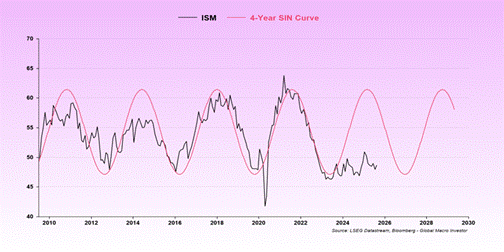
ISM vs. 4-Year SIN Curve — The Cycle Broke (Source: LSEG Datastream, Bloomberg – Global Macro Investor)
This chart shows the ISM overlaid with the 4-year sine curve I just described. From 2010 to 2022, the ISM followed this 4-year rhythm almost perfectly—peaking roughly every four years, troughing roughly every four years. That’s the same cycle that Bitcoin, the Nasdaq, and commodities all followed. But look at what happened after 2022. The ISM flatlined. It didn’t bounce on the 4-year schedule. The sine curve says the ISM should have already peaked by now and be heading back down. Instead, it just hit 52.6 and is accelerating higher.
The 4-year cycle broke. Something is clearly different.
The 5.4-Year Cycle Explains It
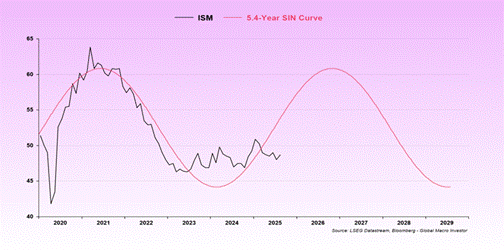
ISM vs. 5.4-Year SIN Curve — The Extended Cycle (Source: LSEG Datastream, Bloomberg – Global Macro Investor)
Now look at the same ISM data overlaid with a 5.4-year sine curve—adjusted for the COVID-era debt maturity extension. The fit is much better. The ISM’s flatline through 2023–2025 wasn’t a broken cycle. It was a delayed cycle. And the 5.4-year curve says the ISM is now in the early stages of a multi-year surge that should peak around 60 in late 2026 to early 2027.
Today’s 52.6 reading is the ISM confirming this trajectory in real time.
Falling Rates Point to a Rising ISM
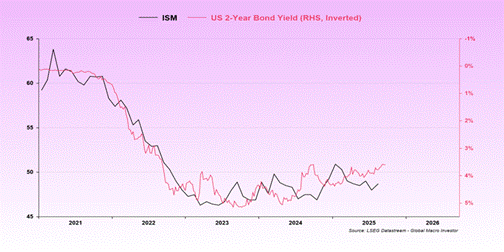
ISM vs. U.S. 2-Year Bond Yield (Inverted) — Rates Lead the ISM Higher (Source: LSEG Datastream – Global Macro Investor)
This chart shows the ISM plotted against the U.S. 2-year bond yield on an inverted axis. The relationship is clear: when the 2-year yield falls, the ISM rises. The 2-year yield has been falling since late 2023 as the market prices in rate cuts. And this is important for the Kevin Warsh debate I’ll explain later: even if Warsh tightens the back end of the curve by shrinking the balance sheet, the front end—the 2-year—is going lower because short-term rates are being cut. The ISM follows the front end, not the back end. So the ISM is going up regardless of what Warsh does with the balance sheet.
Liquidity and Financial Conditions Point to a Rising ISM
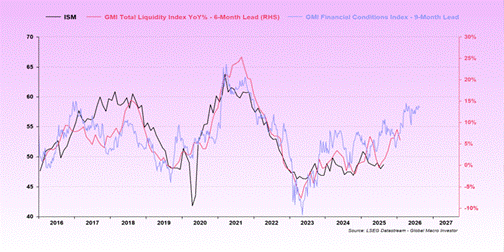
ISM vs. Global Liquidity (6-Month Lead) and Financial Conditions (9-Month Lead) (Source: LSEG Datastream – Global Macro Investor)
This is the chart that ties the whole framework together. The ISM is plotted against two leading indicators: Global Macro Investor’s Total Liquidity Index (with a 6-month lead) and the GMI Financial Conditions Index (with a 9-month lead). Both are pointing sharply higher. Financial conditions have been loosening for months. Global liquidity is turning up. And both of these lead the ISM by 6–9 months. Today’s 52.6 print is just the beginning of what these leading indicators say is coming.
Taiwan Export Orders Are Leading the Way
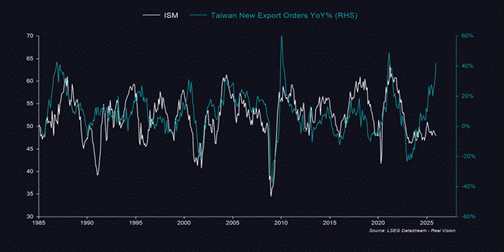
ISM vs. Taiwan New Export Orders YoY% — Semiconductors Leading the Cycle (Source: LSEG Datastream – Real Vision)
This chart from Real Vision’s MIT Monthly report shows something I find remarkable. Taiwan new export orders—which are essentially semiconductor orders, driven by AI chip demand—have historically tracked the ISM closely. But look at the right side of the chart: Taiwan exports are surging to levels not seen since 2021, while the ISM is only now starting to catch up. This is the AI-driven production cycle showing up in real-world manufacturing data. And it’s a powerful leading indicator that the ISM has much further to run.
Bitcoin’s Implied ISM Says the Cycle Changed
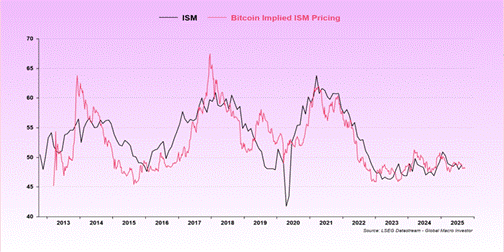
ISM vs. Bitcoin Implied ISM Pricing (Source: LSEG Datastream – Global Macro Investor)
This chart overlays the actual ISM with “Bitcoin Implied ISM Pricing”—essentially what the ISM would need to be to justify Bitcoin’s current price based on the historical relationship between the two. In every prior cycle, Bitcoin’s price and the ISM moved in lockstep. When the ISM peaked, Bitcoin peaked. When the ISM troughed, Bitcoin troughed. But look at the right side: The ISM has stayed in contraction causing a drag on Bitcoin’s price. The ISM is now catching up on the 5.4-year schedule. Today’s 52.6 print is the ISM finally starting to move up.
And Most Importantly: Bitcoin Doesn’t Top Until the ISM Hits 60
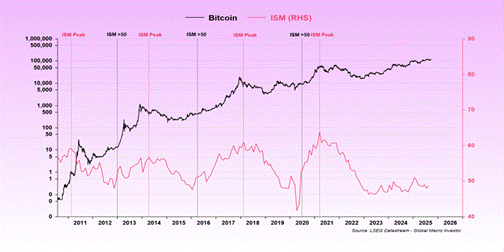
Bitcoin (Log Scale) vs. ISM — Every Bitcoin Top Has Come Near ISM 60 (Source: LSEG Datastream – Global Macro Investor)
This is the chart that, more than anything else, tells me the cycle isn’t over. In every Bitcoin cycle— 2011, 2013, 2017, 2021—Bitcoin’s major price top has occurred when the ISM was at or near 60. Not 50. Not 52. Sixty. The ISM just printed 52.6 and is accelerating. If the historical pattern holds, Bitcoin doesn’t make its real cycle top until the ISM reaches the 58–62 range. We’re nowhere near that.
This is not hope. This is not me rationalizing a position. This is the ISM—the most-watched business cycle indicator in the world—confirming in real time that the cycle extended, the business cycle is turning up, and Bitcoin hasn’t made its real top yet.
The Micro View: Bitcoin’s Silent IPO
The macro explains why the liquidity was delayed. But there’s also a micro-level story for why Bitcoin specifically stalled—and it comes from Jordi Visser’s brilliant framing of what he calls Bitcoin’s “Silent IPO.”
Every great investment has a liquidity event. In traditional finance, that’s the IPO—the moment when early investors who took crazy risks finally get paid. When that happens, the stock often chops around for a while. Not because the company is broken, but because the earliest holders are methodically taking life-changing profits.
Visser argues Bitcoin had exactly this kind of moment. In 2025, Bitcoin went mainstream. ETFs are real. Institutional channels are real. Corporate treasuries are real. Sovereign wealth funds are sniffing around. For the first time, there’s enough market depth for the original holders—the OGs who mined Bitcoin at $5 or bought it at $100—to exit significant positions without nuking the market.
That’s not bearish. That’s maturation.
On-chain data shows old coins—dormant for years—becoming active. Not in panic. Methodically. This is distribution from concentrated, early hands into broader, institutional hands. It’s exactly what happens when Amazon or Google or Facebook IPO’d and lock-up periods expired. The stock didn’t crash. It consolidated. Ownership transferred. And then the real institutional run began.
Once the sellers finish, the buyers are still there. And the next marginal buyer is bigger.
The Liquidity Disconnect: What Raoul Pal Confirmed This Weekend
On February 1, 2026, Raoul Pal posted something that connected a crucial dot. He revealed that Bitcoin and SaaS stocks are trading on the exact same chart—both have been punished not because their fundamentals broke, but because U.S. liquidity specifically has been held back.
The Reverse Repo was essentially drained in 2024. The TGA rebuilt in July and August with no monetary offset. Then came two government shutdowns. The result: a temporary drain in U.S. liquidity that starved the longest-duration assets—Bitcoin and SaaS—while gold absorbed all the marginal liquidity in the system.
There is no disconnect. It’s The Everything Code at play. It’s just that U.S. liquidity, not global liquidity, has been the dominant driver at this phase. And U.S. liquidity has been temporarily constrained by plumbing issues, not by fundamental deterioration.
The current government shutdown is the final hurdle. Once it resolves—and signs point to this week—the liquidity flood begins: the SLR exemption, the partial drain of the TGA, fiscal stimulus from the One Big Beautiful Bill, and continued rate cuts.
As Pal put it: “Often in these full-cycle trades, it is time that is more important than price. Things need to play out.”
But What If I’m Wrong? Playing Devil’s Advocate Against Myself
I’ve just laid out the full case for why I believe this cycle extended. The macro framework. The ISM confirmation. The liquidity mechanics. The micro distribution story. It’s a compelling narrative.
But I owe you honesty. Because there’s a version of this story where I’m the guy who nailed five dates in a row from December 2023—and then abandoned the framework that got every single one right.
Think about that for a second.
The February 2024 date? Worked. The October 2024 date? Worked. The June 2025 date? Worked. The October–December 2025 sell window? Worked. Every single Gann date I predicted played out. And my original February 2026 call said: the top is confirmed, sell now.
So why am I suddenly overriding the framework that got every prior call right?
I need to be brutally honest with myself: there’s a real possibility that my updated view is driven by confirmation bias. I didn’t sell when I said I would. And now I’m constructing a macro narrative to justify the position I’m stuck in, rather than the position I’d take if I were starting from scratch today.
That’s the hardest thing about markets. The narrative always feels different when you’re sitting in the moment. Let me walk you through what the price action is actually saying this morning—and where the evidence genuinely cuts against me.
The Charts: What I See This Morning
I’m looking at five different Bitcoin charts as I write this, and four of them support my view. But the fifth one is the one that should keep me up at night. Let me share all of them.
The Daily Wave Count
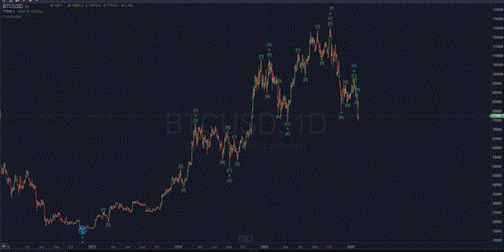
Daily Wave Count — Full Cycle from 2022 Lows
This shows the full cycle from the 2022 lows to today. I’ve labeled the entire move from ~$15,000 to $125,000 as a larger wave 1 (with a question mark), and the current decline as a larger wave 2 correction. The A-B-C structure of this correction looks like it could be nearing completion with price sitting around $77,500.
If this reading is correct, what comes next is a wave 3—and wave 3s in Elliott Wave theory are typically the longest and most powerful. That would be wildly bullish.
But here’s the bearish read: What if the entire move from $15k to $125k wasn’t wave 1 of a larger structure? What if it was a completed five-wave cycle? In that case, the correction has much further to go. In prior Bitcoin cycles, price corrected 77–85% from the cycle high. Even a “mild” 65% correction from $125,000 puts you at $44,000. The current $77,000 level represents less than a 40% drawdown—which historically has been the minimum Bitcoin gives back at cycle tops, not the maximum.
The 4-Hour Wave Count
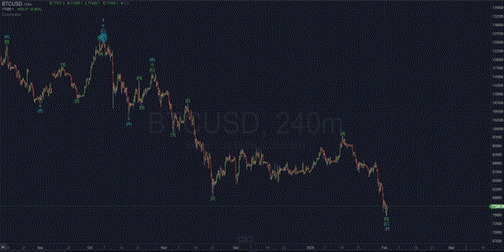
4-Hour Wave Count from the October 2025 Top
This shows a three-wave decline from the top, with what I’ve labeled as waves [1] through [5] completing the third wave (C), and a “2?” at the bottom near $74,000. My reading: a completed three-wave structure (wave C down), with the current level potentially being a wave 2 bottom before an explosive move higher.
The bearish read: That question mark on the “2?” label tells you everything. When your own labels have question marks, that’s worth pausing on. What I’ve labeled as waves (A) through (C) could be wave 3 of wave [A] of a larger corrective structure—meaning waves [B] and [C] are still ahead. A [B] wave bounce to $90,000–95,000 could feel like the bottom is in, only for a devastating [C] wave to take price to $50,000–60,000.
The RSI Divergence
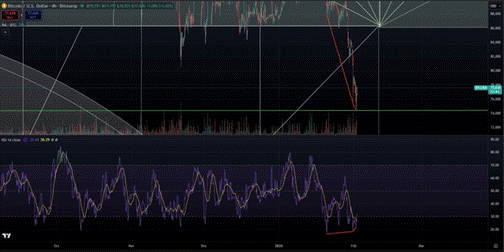
4-Hour RSI Divergence — Potential Bullish Signal
The 4-hour RSI shows a potential bullish divergence—price making lower lows while RSI makes higher lows. Momentum is waning on the downside even as price pushes to new lows. This supports the bottom thesis.
But: RSI divergences on lower timeframes routinely fail in strong third waves down. They’re “buy” signals in corrections and “traps” in impulses. If the hourly count is right and we’re in a wave 3 down, this divergence could resolve with a short-term bounce to $82–85,000 that feels like the bottom is in—only to reverse violently. The RSI reading of 26 is deeply oversold, which typically produces a bounce. But oversold can stay oversold far longer than anyone expects in true bear markets.
The Gann Support Chart
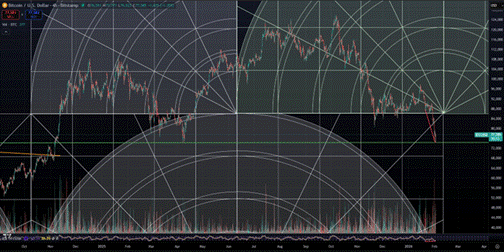
Gann Box Support — Price Touching the Arc
Price is sitting right on the Gann arc support and the horizontal green line around $74–77,000. The Gann geometry I’ve been using to track time and price is showing this as a critical level.
Here’s where I might be wrong about the box placement: When price moved into the “new realm” above my original Gann boxes, I repositioned the boxes higher. But if the top really is in at $125,000 and the original cycle framework was correct all along, then the original box placement was right—and the “new realm” was just the cycle’s blowoff top, not a structural shift. In that case, the Gann arcs I’m now using as support were drawn from the wrong anchor point, and the real support sits significantly lower. The fact that price is touching my arc right now could be giving me false comfort if the arcs were anchored to the wrong starting point.
The Hourly Wave Count — The Chart Against Me
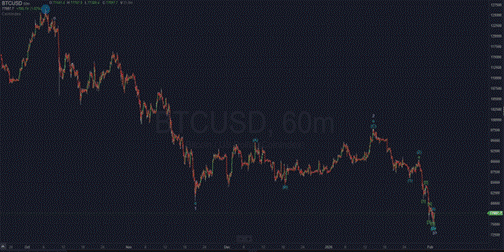
Hourly Wave Count — Potential Wave 3 Down Still Developing
This is the chart that genuinely concerns me. I’ve labeled what looks like a wave 1 down from the October top (to around $81,000 in mid-November), then a corrective wave 2 up to ~$99,000, and now a developing wave 3 down. Within that wave 3, there’s a nested structure of sub-waves—(1), (2), and then [1], [2], [3], [4]—with what appears to be a (3) or “3?” forming near $74–75,000.
Here’s why this should scare me: If this is a third wave of a larger impulsive decline, it could be in the early-to-middle stages of the most powerful wave in Elliott Wave theory. Wave 3s are the longest and most violent. A typical wave 3 extends 1.618 times the length of wave 1. If wave 1 was roughly $125,000 to $81,000 (about $44,000), a 1.618 extension from the wave 2 high of $99,000 would target somewhere in the $28,000–30,000 range. Even a more modest 1.0x extension would target around $55,000.
That’s a very different destination than a bottom here.
And this isn’t some obscure alternative count. The hourly structure is clean: the sub-waves are proportional, the corrective waves are shallow, and the selling has been relentless. If this wave 3 is still unfolding, every bounce I’m interpreting as “the bottom” could just be a brief correction within a much larger move down.
The Bigger Case Against Me
Beyond the charts, there are structural reasons my updated thesis could be wrong.
The cycle extension thesis is an assumption, not a confirmation. My entire updated view rests on one idea: the 4-year Bitcoin cycle stretched to 5.4 years because of COVID-era debt maturity extensions. That’s a compelling macro argument. But it only works if liquidity actually arrives on time. I’m betting that 2026 is when the refinancing wall forces liquidity into the system. What if it doesn’t? What if the government shutdown drags on? What if the SLR exemption gets delayed? What if Warsh’s balance-sheet-tightening instincts kick in before the rate cuts take effect?
Warsh could be genuinely bearish. Darius Dale at 42 Macro explicitly warns that Warsh’s core principles include shrinking the Fed’s balance sheet to drain financial-sector liquidity. Lower rates with a smaller balance sheet is not the same as lower rates with QE. It could steepen the yield curve and tighten financial conditions even as the front end falls. Dale calls this “Paradigm B” and says it could mean prolonged bear markets in risk assets. I’ll address the timing of Dale’s scenario shortly—and why I believe it arrives later than he suggests—but the risk is real.
Bitcoin’s “IPO distribution” could have further to go. Visser himself said these distribution periods typically last 6–18 months. If the heavy distribution started in mid-2025, it could easily continue into late 2026. That’s not a setup for an immediate explosive rally—it’s a setup for more grinding, frustrating sideways-to-down action.
The “rhyming” argument can justify anything. Here’s the hardest truth. The same logic that says “this cycle’s lows were last cycle’s highs, so February 2026 is a bottom instead of a top” can also be used to say “this cycle’s selloff will be deeper than last cycle’s because the blow-off was less impressive.” The rhyming framework is flexible enough to fit almost any outcome after the fact. That makes it a useful lens for analysis, but a dangerous foundation for conviction.
And maybe the simplest argument against me: I nailed five dates in a row using one framework. Every single date played out. The framework says February 10, 2026 confirms the top. And I’m choosing to override it. History says trust the system that’s been working, not the narrative that sounds good in the moment.
So Why Am I Still Holding? The Risk/Reward.
After everything I just said, you’re probably wondering why I’m not selling right now.
Here’s the short answer: even with all the bearish arguments, the risk/reward for holding still makes sense to me. And it comes down to the Gann dates themselves.
If I’m right and the cycle extended, the ISM is heading to 60, liquidity is flooding the system, and what comes next could be explosive.
If I’m wrong and the original December 2023 framework was right all along, the Gann dates tell us we bottom around October 2026 and begin a new cycle. Price could go as low as $40,000–50,000 before that bottom. That would be painful. I’m not going to sugarcoat it.
But if you have the patience to hold through it—if you can stomach another 4 years—history shows Bitcoin will once again make new all-time highs. It has done this every single cycle.
If I’m right, we do incredibly well in the short term. If I’m wrong, we just need to hold, have patience, and we’ll recover.
Either way, selling here—at what could be the bottom of either a cycle correction or a cycle extension—is the one move that guarantees you miss the upside in both scenarios.
Now let me walk you through the economic forecast and the political dynamics that reinforce this view.
My 2026 Economic Forecast
Let me summarize where I think the economy is headed, because this backdrop is what fuels the Bitcoin thesis.
The U.S. Economy Is U-Shaped and K-Shaped
U-shaped means growth was slowing in 2025 (down the first leg) due to economic uncertainty from tariffs and fiscal retrenchment, but is searching for a bottom in Q4 2025 and will start recovering in 2026 (up the second leg) due to fiscal enhancements like the impacts of the One Big Beautiful Bill—more money in pockets from no tax on tips and overtime—and the impacts of AI, data center, and energy build-outs.
K-shaped means monetary policy has largely resulted in asset price inflation since the 2008 crisis, causing those at the top of the economy to do even better while those at the bottom—low-to-median-income consumers—do worse as goods and services inflation outpaces wage increases.
Scott Bessent and Stephen Miran understand this dynamic. The Democrats are already building a midterm platform around the argument that Trump hasn’t fixed the affordability crisis. The current administration knows they need to “solve” this early in 2026 or they’ll get crushed in the midterms. As the old saying goes: “It’s the economy, stupid.”
Rates Are Going Lower
Low-to-median-income consumers, small businesses, and interest-rate-sensitive sectors need relief. Creating growth for them is more important to this administration than fighting inflation. This is why Trump, Bessent, and Miran are pushing for drastically lower interest rates, and why the replacement for Jerome Powell will be supportive of this policy.
There’s also a debt refinancing wall that started in 2025 and intensifies in 2026–2027 as the zero-percent COVID-era debt rolls over at current rates. Refinancing at these rates will increase the fiscal deficit even further.
Conclusion: Rates are going lower throughout 2026.
Liquidity Is Coming
There’s not enough liquidity to refinance all the debt—and that’s already showing up in spikes in overnight lending rates in the Repo market. Those spikes are what caused the market volatility from October to December.
This means liquidity is coming. They won’t call it QE because that’s a politically toxic term, but functionally QE is coming. The Fed has already ended quantitative tightening and quietly resumed balance-sheet expansion through what they’re calling “Reserve Management Purchases.” They’ll tell you it’s “technical.” They’ll swear it’s “not QE.” But the balance sheet has stopped shrinking and is starting to grow.
Bessent and Miran understand that if the Fed provides QE, it leads to asset inflation—which is what caused the K-shaped economy in the first place. So they’re looking to shift the liquidity mechanism from the Fed to Treasury, delivering it directly to Main Street rather than Wall Street. That’s necessary for the Republicans to win the midterms.
Conclusion: The business cycle, ISM, and economy pick up and perform well in 2026 to 2027.
The Fed Chair: Why Pal Is Right Short-Term and Dale Is Right Long-Term
On the subject of Kevin Warsh’s nomination as the next Fed Chair: there’s a false narrative that Warsh is a hawk. As Raoul Pal bluntly put it, “It is utter nonsense. These were comments mainly from 18 years ago.”
Warsh’s job and mandate is to run the Greenspan-era playbook. Trump has said this. Bessent has said this. Cut rates. Let the economy run hot. Assume the AI productivity boom will keep core CPI in check. Just like 1995 to 2000.
Per Darius Dale at 42 Macro, Warsh has a Jacksonian view of the Fed’s role. His core principles—leaning into AI-led disinflation, shrinking the Fed’s footprint, overhauling bank regulation to favor small and medium banks over large ones—align with the Trump-Bessent vision. Trump wants lower rates and a booming economy. Bessent wants control of banking regulation and a stable dollar. Warsh wants a smaller Fed that gets out of the way.
Now, here’s where I disagree with Dale on timing—and this is a critical distinction.
Dale warns that Warsh’s balance-sheet-tightening instincts could trigger “Paradigm B”—prolonged bear markets in stocks, gold, and risk assets. I respect Dale’s work enormously. But I think he’s right about what Warsh wants to do and wrong about when Warsh can do it.
The math won’t let him. Not yet.
The U.S. government has roughly $9 trillion in debt maturing over the next 12 months. That debt was issued at near-zero COVID-era rates and has to be refinanced at current rates. If Warsh simultaneously shrinks the Fed’s balance sheet—removing a major buyer of Treasuries from the market—while the Treasury is trying to sell $9 trillion in new paper, he creates a supply-and-demand catastrophe in the bond market. Yields spike. Interest costs surge. The deficit explodes. You could get failed Treasury auctions—the kind of event that triggers a genuine financial crisis.
Dale himself acknowledges this indirectly. His own framework states there’s a “geopolitically driven supply-demand imbalance in the Treasury bond market and the Fed is the only institution in the world with a balance sheet large and flexible enough to fill the void.” Those are Dale’s words. So even by his own analysis, the Fed can’t step away from the bond market when the refinancing wall is at its peak.
And the political logic is airtight. Trump’s entire second-term strategy revolves around the midterms. He needs to hold the House and Senate to pass the remainder of his agenda and avoid impeachment proceedings. The number one issue for voters is affordability. If Warsh triggers a credit freeze, rates spike, and the economy stalls heading into November 2026, Republicans get wiped out. Bessent—who is the architect of the economic strategy—understands this completely. He’s not going to let Warsh blow up the bond market when the administration needs the exact opposite.
Warsh doesn’t need to be a dove by nature. He just needs to not be politically suicidal. And crashing credit markets during the largest refinancing in history, heading into midterms, would be exactly that.
So Pal’s Greenspan playbook is the right framework for 2026: cut rates, accommodate the refinancing, let the economy run. That’s the path of least resistance and the path that serves the administration’s political interests.
But here’s where Dale becomes right—and it’s why I’m watching 2027.
Once the midterms are won, the political calculus changes entirely. Trump isn’t on the ballot in 2028. He has nothing to lose from tighter policy. And by late 2027, the refinancing wall will have largely passed—the worst of the COVID-era debt rollover is concentrated in 2025–2026. That gives Warsh the window to actually implement his balance-sheet reduction vision. It also aligns with the inflation spike I’m forecasting: if commodity prices and goods inflation are rising through late 2026 into 2027 as the ISM accelerates, that gives Warsh political cover to tighten. He can say “I’m fighting inflation” while actually implementing structural reform.
That’s the elegant timeline: Pal is right in 2026 (accommodate), Dale is right in 2027–2028 (tighten). The bear market Dale warns about arrives—just 12–18 months later than he’s suggesting.
The one risk to this view: Fed Chairs have historically surprised their appointers. Volcker surprised Carter. If Warsh genuinely believes the balance sheet is a moral hazard issue, he might move faster than anyone expects. The counter: Trump has shown zero tolerance for Fed independence. If Warsh steps out of line, Trump will publicly attack him the same way he attacked Powell. And Warsh knows this going in. He’s not naive about who he’s working for.
Beyond 2027: The Bubble of All Bubbles
The Republicans may do enough to win the midterms, but inflation will likely spike into 2027 and 2028. Once the Democrats take control, we can expect the money printer to go full bore just as the productivity benefits of AI arrive—creating the bubble of all bubbles sometime around 2029–2030.
Economy improves 2026–2027 while asset markets move up (led by the S&P 493 in 2026). Then a significant correction as inflation surges into 2027–2028. Then a massive rally into a secular top around 2029–2030.
Back to February 10, 2026: The Dominoes
This is the Gann date that’s been on my radar since December 2023. It’s a “time” window that has a habit of turning the market when price is coiled. I’m not saying the market has to move on that exact day. I’m saying: if you’re looking for a window where multiple dominoes could fall at once, this is the window.
Domino #1: Regulatory Clarity. The GENIUS Act got stablecoins moving toward legitimacy. The CLARITY Act is the next step—market structure legislation defining what’s a security, what’s a commodity, what’s an exchange, what’s a broker. The more clearly Washington labels Bitcoin as “commodity-like,” the more comfortable big money gets. Markets don’t wait for the final signature. They front-run the path.
Domino #2: Government Shutdown Resolution. Shutdowns freeze confidence, jam up approvals, and—most critically—drain short-term liquidity. This is the exact plumbing problem Raoul Pal identified as the reason Bitcoin and SaaS have been starved. Once the shutdown resolves, the TGA can drain, and the liquidity flood I described above can actually begin.
Domino #3: The Fed’s Quiet Pivot. On December 1, the Fed ended quantitative tightening. On December 10, they started buying again with “Reserve Management Purchases.” The balance sheet has stopped shrinking and is starting to grow. This is the turn in the liquidity cycle. Bitcoin doesn’t trade CPI prints. Bitcoin trades liquidity. And the liquidity trajectory just changed.
Domino #4: The Warsh Confirmation. Once the market believes a new Fed Chair is coming—and that the Senate will confirm him—it changes expectations, forward guidance, and what Wall Street is willing to front-run. As I argued above, Warsh will accommodate in 2026 because the math and politics demand it. Bitcoin takes off not when the change happens, but when the market becomes certain the change is coming.
Where I Land
I’ve now spent this entire article laying out both sides. The bullish case. The bearish case. The charts that support me and the chart that scares me. The macro arguments for and against. The political logic. And I’ve been honest about the possibility that I’m rationalizing a position I’m stuck in.
So let me tell you where I actually land.
The Gann framework got every date right. The original call for February 10 was “top confirmed.” The updated view is “cycle extended, this is the bottom.” Those are opposite conclusions from the same system. That should make anyone uncomfortable—including me.
But the macro evidence leans toward the extension. The conditions that killed prior cycles—tightening liquidity, rising rates, Fed hawkishness—aren’t present. The opposite conditions are forming. The refinancing wall forces liquidity. The political cycle forces accommodation. The ISM just hit 52.6—the highest since August 2022—and is accelerating toward the 60 level where Bitcoin has historically topped. And the technical evidence on the daily and 4-hour charts supports a potential bottom—even if the hourly chart is screaming caution.
The Warsh timing argument seals it for me. Dale’s Paradigm B is a real risk—but the $9 trillion refinancing wall and the midterm political calendar make it virtually impossible for Warsh to tighten the balance sheet in 2026. The math won’t let him. The politics won’t let him. And Bessent won’t let him. Pal’s Greenspan playbook is the path of least resistance—and in Washington, the path of least resistance is almost always the path that gets taken.
So I’m holding. Not out of stubbornness. Not out of hope. Because the confluence of time, price, momentum, macro, and political incentives is too strong to abandon for a thesis that requires ignoring all of those signals simultaneously.
But I’m holding with clear eyes. If price breaks decisively below $74,000 and the hourly wave structure keeps extending, I’ll revisit this thesis. The Gann arc will have failed. The 4-hour “2?” label will be invalidated. And I’ll need to seriously consider that the original December 2023 framework was right all along.
I’m not married to being right. I’m married to the process. And right now, the process says hold.
I’ll say something I try not to say too often:
You don’t get a lot of second chances in Bitcoin.
The market gives you boring months—sometimes boring years—and then it gives you 60 days where everything changes. If I’m right about the timing window—not the exact day, the window—then early February could be one of those “everything changes” moments.
And if I’m wrong? We bottom around October 2026 and begin a new cycle. It will be painful. But every single Bitcoin cycle in history has produced new all-time highs on the other side. Every single one.
I could be right with the change in view. I could be wrong with the change in view. But missing out on the potential upside if I’m right is asymmetrical compared to having to hold for four years if I’m wrong.
And when Bitcoin goes, it goes fast.
Make sure you’re not the person trying to catch it mid-air.
Because if I’m right… you’re not prepared.
Heck, I may not be either.
*Educational purposes only, not financial advice.
Want more insights like this? Subscribe to the CPA Gone Mad Newsletter for free updates.